Monday, November 14, 2011

Thanksgiving Lesson Plan

Since we are starting to transition into the holiday spirit I have decided to pick a lesson plan to help do just that. This lesson on Thanksgiving is entertaining for elementary school students. And most importantly it is great for all learners. These units are written to follow the TESOL (Teaching English to Speakers of Other Languages), and for ESL (English Speaking Learners); standard 2, goal 2 (Haynes, 2011).


This lesson will help students learn about Thanksgiving as far as terms, events, culture and more in a effective instructional strategical way for educational development. 
Lesson Topic

Thanksgiving; The Mayflower

Proficiency/Grade level

Beginner, advanced beginners, grades 1-4

Content Concepts and Skills

Vocabulary development for the holiday of Thanksgiving; social studies concept of the settling of the New World.

Vocabulary Needed

Pilgrim, Mayflower, passenger, freedom pray, king, Native Americans, tools, plant, hunt, build, crowded, hungry, dirty, equal, rules, warriors, harvest,turkey, lobster, corn, squash, pumpkins. Vocabulary will vary according to grade and English language level.

Instructional sequence for Grades 1-4 beginners & advanced beginner ESL students

  • Look for a book with simple pictures in it about the Pilgrims and the Mayflower. Try one of the following for ESL students in grades 1-4:
  • 1. The First Thanksgiving by Linda Hayward
    To make difficulty level of your book irrelevant, tell the story using the pictures in the book. Review the story several times by asking students to point to the Mayflower, the Pilgrims, etc. First and second graders like to hear about the children on the Mayflower. When you read the story of the First Thanksgiving, emphasize the reasons the Pilgrims left England, the hardships of the voyage, and the terrible first winter.
     
  • Give students a sense of how crowded the Mayflower was by making a rectangle on the floor of your classroom with masking tape. Make your rectangle small enough so that when your students all stand inside of it, they feel crowded.
  • Have students download the pattern for the Mayflower and for the sail pattern. Have students draw lines for boards and color the ship. Fold on the lines so that the ship stands. Cut out two copies of the sails and put the masts between the sails. Glue to the ship. Make the ship stand up on a sheet of light blue paper. Students can make an ocean by drawing waves on the paper with a dark blue marker.
  • Brainstorm 4 or 5 important facts about the Mayflower as a group and write these facts on sentence strips. There should be a strip for each student in the group. Students should be able to sequence these strips.
  • Have students write one of the facts on a sheet of paper & learn to say that fact.
  • Present the story of the Mayflower to the ESL students' classes.
  • If students are older but don't speak much English, use the Thanksgiving booklet.
  • Have students in Grades 2-4 recreate a Pilgrim house by downloading PDF files House pattern, thatched roof pattern, and door and chimney pattern. Students should learn about the materials used to build houses in 1620 and discuss how they were built.
  • Show students how to make the out side of the house with brown construction paper, a door which opens and no windows. Make the thatch roof by cutting a piece of dark gold construction paper and drawing the thatch with a marker. Add a stone chimney.
    Download Pilgrim house interior. Have students complete the directions for the inside of the house: chimney for cooking, warmth, and light; the iron kettle brought from England; and a few pieces of wooden furniture.
    Cut a piece of lined paper the shape of the house. Have students write about the Pilgrims' house.
    Arrange your houses on a large sheet of paper on a wall or bulletin board and draw in the colonial village.
  • Have students go to Design a Period House Interior. To reach this page, click on the title on the right side of the page.
  • Students can compare and contrast life as a Pilgrim child and their life in the U.S. in 2001 using a Venn diagram. They can also compare Thanksgiving in 1621 and Thanksgiving in 2001.
  • Have classes write an E.S.L. compact of rules for getting along with each other in school. Have students make a turkey with one of the rules written on each of the feathers.
  • Have students in Grades 4-6 compare the facts that we know about Thanksgiving and the myths. A good source for doing this is found at Read, Write, Think which is a site sponsored by NTCE.

Resources: 
Haynes, Judie. (2010). Lesson Plans. In Thanksgiving Lesson Plan. Retrieved November 14, 2011, http://www.lessonplans.com/ext-resource.php?l=http://www.everythingesl.net/lessons/gobble.php

with knowledge!!!!

Tuesday, October 11, 2011

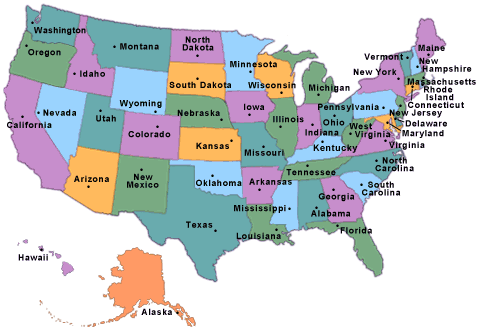
The 50 States


Geography Lesson On the 50 States


As an Elementary school teacher; as I would like to become keeping in mind that children love to be visual learners is a great strategy to have when teaching lessons. I myself am a visual learner and as a younger student I loved to learn new things by seeing how to learn new things. This lesson you have about to read is a great way for younger students to learn important facts about all of the United States' 50 states. 


                                              Click link above for lyrics & subtitles


Subject – Social Studies

Grade Level – 2nd/3rd

Subject Area: Geography
Major Objective: To identify the location of a state, compare population sizes from various states, learn the state bird, flag, and location on the map.
Materials: Giant floor map of the United States, black and white US maps, yellow, orange, & red crayons.
Related URL’s: http://www.50states.com
http://www.50states.com/bird
http://www.50states.com/flag
http://www.askjeeveskids.com
Time Required: Social Studies periods for about 3 weeks, plus a couple of computer lab periods.
Activities and Procedures: Recently as a part of the census, we were given a floor size map of the United States, made of a durable material. The states are colored red, orange, and yellow based on the population of the particular state. This is a great visual.
Each student will pick the name of a state from “a hat”. They will have to have located that state on the giant map and record the color. They can then go to the key to see what population size that color represents.
Then, during computer class, we can go to the lab and do some research about our state. We will go to http://www.50states.com to find out the name of the capital city of this state. From there we will go to http://www.50states.com/bird to located the state bird. Then a picture of the bird can be printed out. From there we will go to http://www.50states.com/flag to find out about that state’s flag. Once again, a picture of the flag can then be printed out.
Finally, we will access http://www.askjeeveskids.com to locate a map of the stated, which outlines the shape as well as other cities.
Follow-Up/Extension: Once all of the necessary material has been found about the various states, each student will be responsible for presenting his/her state to the class, based on the information that they have located. Each of the students in the class will have a black and white copy of the U.S. map, so when a state is being presented, they can color in that particular state the appropriate color, based on population size. Each student can display their pictures about their state on poster board, to be displayed around the room.

Sources

Lesson Plan: http://www.lessonplans.com/ext-resource.php?l=http://www.lessonplanspage.com/SS50StateGeography23.htm

Video: http://www.youtube.com/watch?v=sNUDDaEOvuY & http://www.youtube.com/watch?v=MSvJ9SN8THE&feature=related (Lyrics and subtitles).

Picture: http://www.infoplease.com/states.html

Sunday, September 25, 2011

The Story of PING

As an educator it is important for them to teach well and effectively, especially if they are working with younger students as I would like to do. Children have short attention spans and  need to be entertained. It is important that instructional teaching strategies are used to insure educational development. 

"The Story About PING" By: Marjorie Flack & Kurk Wiese is a unique and interesting story for children to use effective thinking strategies before, during, and after a story (Murray, 2011).  This lesson plan caught my eye because this it's a great story when working with diverse students and it gives them a look at other cultures. Hope you like it!


Aim: To demonstrate how stories may provide insight into a culture
Aim: To enable students to use effective thinking strategies before, during, and after a story.
Motivation: Students will be invited to travel to China using the wings of their imagination. Through pictorial example, map, globe, and song, the words related to China are introduced. The principle aim is elicited from the students. Additional vocabulary is introduced in preparation for the Story of Ping by Majorie Flack by producing items of food and clothing et al. from the culture of China.
Development: The use of this fictional tale provides one with an opportunity to reinforce understanding of new vocabulary in a contextual setting as well as enable students to see how a story instructs as well as entertains. Other communication arts strands are tapped as children appreciate the sound of language and create mental images. Students will note the food, clothing, and shelter of the people of China on their journey. They will also listen to see if Ping is a naughty (like Peter Rabbit) or a nice little duck.
Summary: The summary serves to assess the student’s ability to articulate how information is transmitted by word of mouth. Students are guided as they determine the message the storyteller is imparting. The students will make inferences as they determine who was wise and who was foolish in the story and give the reasons why.
Follow up: The students are given an opportunity to create a seascape of Ping’s home on the Yangtze River. Using the 5Ws, the children will show who Ping is in the drawing, where he lives, when the story takes place (day or night), what Ping is doing, and why. Students will write a sentence about their picture, and share it with the class.
Standards
E2b Produce a response to literature
E5a Respond to fiction using interpretive and critical processes.
E3a Participate in one-to-one conferences with the teacher.

Saturday, February 5, 2011

Seven Fat Cats


INSTRUCTIONAL STRATEGY LESSON PLAN


While working with children an educator must keep in mind that children have a very short attention span. Keeping them entertained during a lesson plan is a great way to ensure effective educational development. Children should feel like they want to learn along with teachers who should want to teach. Not only should teachers want to teach but they should be great at it and having certain strategies when trying to plan and teach a lesson is a great way to start . Learning should be a fun and educational experience for everyone including the teacher. On my journey to becoming an educator myself, I have seen a lot of interesting ways to get children involved, rather then just telling them what chapters to read, giving notes and assigning homework.


"Seven Fat Cats" is a book written by Joy Cowley and this story is a great way to get children to learn how to put sounds together. I love kids and Seven Fat Cats is a fun, unique and exciting way to get children involved in wanted to be educated. I would love to try this lesson someday with my students. Hope you like it!


Summary:
While reading the story "Seven Fat Cats", students will listen and match the sounds (rhyming, beginning, ending, and vowel.)
Main Curriculum Tie: 
1st Grade - Content
Standard 1 Objective 3
Develop and use skills to communicate ideas, information, and feelings.
Materials:
·         Seven Fat Cats by Joy Cowley
·         Seven Fat Cats sound boards—one per child
·         counters
Additional Resources:
Irresistible Sound-Matching Sheets with Lessons that Build Phonemic Awareness by Janiel Wagstaff (Scholastic Professional Books)
Attachments
·         cat_sound_board.pdf
Seven Fat Cats Sound Board
·         cat_word_list.pdf
Sound Board Lesson for Seven Fat Cats
Intended Learning Outcomes:
Intended Learning Outcomes
5. Understand and use basic concepts and skills.
6. Communicate clearly in oral, artistic, written and nonverbal form.
Process Skills
Symbolization, observation, description, prediction
Instructional Procedures:
Invitation to Learn
“Have you ever seen a cat sitting on a wall? This story is about seven fat cats sitting on a wall.”
Instructional Procedures
First, read the story for enjoyment. Before the second reading, ask the children to listen for rhymes and look for a pattern. Discuss what they observed in listening to the story. Have the children read the story with you the second time.
Steps to follow for sound board activity:
1.     Pass out one Seven Fat Cats sound board to each child.
2.     Pass out counters (approximately 25 per child).
3.     Identify the pictures at the top of the columns on the sound board (five, three, cats, wall).
4.     Have the children listen and match the sounds (rhyming, beginning, ending, and vowel). Choose no more than two of these for a day’s lesson.
5.     Set the focus. For example, say “We are going to listen for rhyming words. The word to match is hive. Say hive.” Children repeat “hive.” The teacher asks, “Which word rhymes with hive? Let’s see. Say the words with me. Five - hive, three - hive, cats - hive, wall - hive. Which word rhymes with hive? Place a counter below the picture. Say the rhyming word when you see five fingers.” (This provides think time for the children.) Children answer “five.”
6.     Reinforce the responses of the children and scan their desks to observe how the children are doing individually. Move to beginning sounds, ending sounds, or vowel sounds following the same procedures.
7.     Remember to focus on no more than two types of sounds during a day’s lesson.

Extensions:
Possible Extensions/Adaptations
Sing “Seven Fat Cats” to the tune “Mary Had A Little Lamb”. Have seven children act out the story as the rest of the class reads the story. The next day, read the story again and have seven different children act out the story as the rest of the children read it. 
Assessment Plan:
Could the children retell the story?
Did the children make any text to self or text to text connections after hearing the story?
Could the children remember the rhyming words?
Did the children predict the story pattern?
Were the children able to hear the focus sound in the sound board activity? 


Source:
http://www.uen.org/Lessonplan/preview.cgi?LPid=5640